

2/3/2026
The early weeks of a Division III men’s volleyball season are often defined by discovery. New lineups take shape, freshmen find their footing, and teams begin to reveal what they truly are. Some squads show their firepower right away. Others lean on serve pressure or depth.
But in February of 2026, one theme is already emerging across the country with clarity.
The teams controlling the net are controlling the sport.
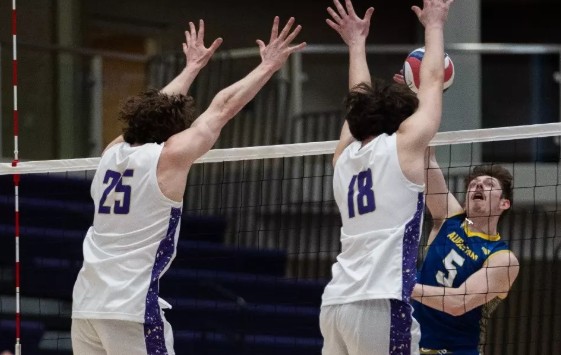
Blocking has always been volleyball’s quiet force. It does not always earn the glamour of a ten-kill set or a match-winning ace, but it changes matches just the same. The best blocking teams do more than score points. They reshape offenses. They take away seams. They force hesitation. A strong block makes the court feel smaller, the attack window tighter, and the margin for error almost nonexistent.
And through games played on February 1, the national blocking leaders are already giving Division III fans a glimpse of where this season may be headed.
At the very top of the NCAA leaderboard sits Dominican (IL) junior Thomas Hirsch, a 6-foot-7 presence who has opened 2026 with a staggering 1.812 blocks per set. Through only 16 sets, Hirsch has already totaled 29 blocks, the kind of production that immediately establishes Dominican as a team with teeth at the net.

Dominican is not just receiving early attention because of Hirsch’s numbers. The Stars have positioned themselves among the national contenders, opening the year inside the top tier of the InsideHitter team rankings and quickly showing that their defensive identity is real. A blocker averaging nearly two per set is not simply having a strong weekend. That is a player dictating the terms of play.
Behind him, one of the most exciting early-season developments has been the arrival of freshman blockers making immediate national noise.
Wheaton (MA) first-year middle Jeremy Bullard-Smith has wasted no time announcing himself at the Division III level. Despite being only a freshman and standing 6-foot-3, Bullard-Smith has posted 1.600 blocks per set, placing him second nationally. In just 10 sets played, he has already collected 16 total blocks.
Blocking success that early is rarely accidental. It speaks to timing, instincts, and a comfort level at the net that usually takes years to develop. Bullard-Smith is not playing like a newcomer. He is playing like a defensive cornerstone.
The freshman impact continues down the list with Kean’s Caden Krzyzak, another early-season net disruptor. Krzyzak has totaled 25 blocks already and sits among the national leaders at 1.389 blocks per set, giving Kean a physical edge that could elevate their ceiling as the season builds. For programs outside the preseason spotlight, a breakout freshman blocker can change the trajectory of an entire spring.

While the individual leaders stand out, some of the most telling stories are coming from programs where blocking is not just an attribute, but a system.
Penn State Behrend is a prime example. Few teams have multiple players clustered near the top of the national leaderboard the way Behrend does. Senior Joseph Sciscio ranks in the top five at 1.286 blocks per set, while fellow senior Lewis Rhodes and sophomore Jack Wilcox also remain firmly inside the top 20.
That kind of concentration is not random. It is a reflection of a program that has built its identity around net control. When a team has three blockers producing at that level, opponents cannot simply avoid one matchup. They have to solve the entire front line.


And in Division III, where offensive rhythm is everything, a disciplined blocking unit can become the great equalizer, pulling opponents out of tempo and forcing uncomfortable decisions.
Perhaps no team illustrates the connection between blocking dominance and championship ambition more clearly than Cal Lutheran.
The Kingsmen have exploded out of the gate in 2026, sitting near the very top of the InsideHitter national rankings with a powerful start and a set record that reflects complete control. Their early success has been built not only on offensive efficiency, but on the ability to close points at the net.
Junior Matthew Wilcox, standing 6-foot-7, has emerged as one of the nation’s premier defensive weapons, averaging 1.188 blocks per set. Cal Lutheran already looks like one of the most balanced teams in the country, and having a player who can erase attack lanes in the biggest moments is part of why the Kingsmen feel so complete.
Winning in Division III is rarely about one skill. The best teams score in multiple ways. But blocking remains the one skill that can completely break an opponent’s confidence. When hitters begin to see hands pressing over the tape, even the best attackers become cautious.
Rivier’s Tyler Dickinson offers another reminder of how one net presence can tilt a matchup. At 6-foot-11, Dickinson is one of the tallest athletes in Division III volleyball, and he is producing accordingly, averaging 1.059 blocks per set with 36 total blocks already.

Height alone does not guarantee success at this level, but when combined with timing and discipline, it becomes something uniquely disruptive. Dickinson plays the game from above the tape, forcing offenses to adjust their angles before the ball is even set.
Across the country, the early blocking leaderboard is also revealing which conferences may be defined by physical net battles.
The CCIW, led by undefeated Loras, already looks like one of the deepest and most imposing leagues at the net. Junior Roman Rothermel has been a key piece of that identity, averaging 1.045 blocks per set as Loras continues its unbeaten rise through the season’s opening weeks.
Meanwhile, the GNAC continues to produce wave after wave of defensive talent. Lasell’s Nathaniel Cobuzzi, Wentworth’s Conner Foxwell, and Elms senior Rafa Artero are all among the national leaders, underscoring just how rugged the net play has become within that league.
It is important, of course, to recognize the context of early-season statistics. Many of these numbers are built on smaller samples, often fewer than 20 sets. One dominant weekend can shift the leaderboard dramatically.
But even in a limited window, blocking translates. A player does not accidentally average more than one block per set. That requires repeated execution, positioning, hand strength, and court awareness. These athletes are not just compiling stats. They are establishing themselves as anchors.
And as the 2026 season continues to unfold, one reality is already clear. Division III volleyball is being shaped above the tape.
The best teams will always need strong setters, terminal attackers, and consistent serving. But the teams that want to be standing in April will also need players who can change rallies before they ever begin.
Because in volleyball, nothing sends a message quite like a roof.
And right now, across the country, Division III’s blockers are sending plenty of them.