

4/22/26
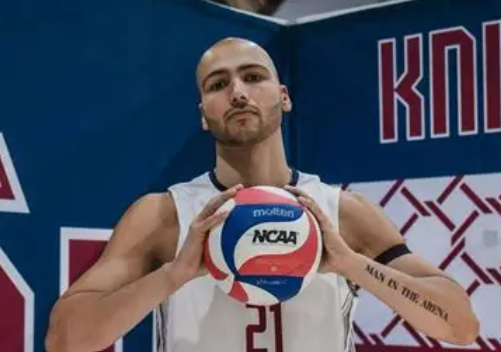
The D3 volleyball world does not claim him. He was a Division I player, an FDU Knight, a Southern California kid who chased the game east across the country when his body had every reason to keep him home. But anyone who has ever stood on a volleyball court, at any level, understands the kind of person Sina Sinbari was. The kind you root for even when you are supposed to root against him. The kind whose story outgrows the sport that introduced him to the world.
Sina passed away Monday, April 21, 2026, at the age of 25, after a four-year battle with desmoplastic small round cell tumors, a rare cancer diagnosed in only a few dozen people each year. He leaves behind his family, his teammates, his doctors and nurses at UCLA Health, and a community of people who learned, through him, what it actually looks like to show up.

The Diagnosis That Rewrote a Future
In the summer of 2022, Sina was 21 years old and two weeks away from reporting to Fairleigh Dickinson University. He had committed to FDU’s men’s volleyball program following its inaugural season, transferring in after a year of junior college and carrying what he described as a chip on his shoulder. This was going to be his moment. His opportunity to play at the highest level, to make his family proud, to make himself proud.
Then his back started hurting. He tried physical therapy. He tried ibuprofen, sometimes four or five at a time just to sleep. He kept lifting, kept going to the beach, kept training. Nothing helped. When he finally walked into an emergency room alone, assuming it was a hernia or a cyst, a doctor delivered words no 21-year-old is prepared to hear: “I’m sorry, but it’s cancer. We just don’t know what type.”
It took two more weeks for UCLA doctors to identify the specific disease. By that point, his grandmother, who had fallen ill around the same time Sina’s back pain began, was in her own battle. Sina kept his diagnosis from her so she would not carry the weight of it. She entered hospice shortly after being discharged home. She passed away soon after, and Sina began his first round of chemotherapy on the day of her funeral. He asked his father to buzz his head that morning, a small ritual of preparation. He live-streamed her service from his hospital bed.
A Fight Measured in Days and Flights
What followed was not a season. It was a war fought on multiple fronts over nearly four years. More than 30 rounds of chemotherapy. Major abdominal surgery in April 2023. Weeks of daily radiation. A stretch of nearly a month hospitalized when his body could no longer absorb what the treatment was asking of it. Through all of it, he kept returning to one goal: getting back on the court.
In January 2024, when UCLA cleared him to train again, Sina flew back to New Jersey and rejoined the FDU program. The team had never had a full healthy season with him. They welcomed him anyway. He could not yet play, so he became something quieter and harder to measure. He showed up early, stayed late, cheered with a volume that felt like competing. The Knights reached their first NEC tournament in program history with him on the bench.
That was not enough for him. He wanted back on the floor. So he started flying. Once a month, after a full day of chemotherapy at UCLA, Sina would take a redeye across the country and be in a Hackensack gym for a 7 a.m. practice the next morning. Two weeks of every month his body was broken. The other two weeks he spent rebuilding it, knowing the cycle would start again.
He did this ten times during his playing season alone.
One Point, One Kill, One Moment
On January 15, 2025, during a match against Barry University, Karl France sent Sina in. It was his first collegiate match since the diagnosis. On the first point he played, he hit a kill.
He went on to appear in 13 matches that season. The Knights reached the NEC semifinals. At the NACDA Convention in Orlando that summer, Sina received the Wilma Rudolph Student-Athlete Achievement Award, honoring student-athletes who overcome significant personal challenges to succeed in intercollegiate athletics. FDU named him its Comeback Player of the Year.
On May 14, 2025, he graduated with a bachelor’s degree in business. He then enrolled at UCLA, pursuing a master’s in Business Law while continuing treatment at the hospital that had become his second home.

What He Gave Away
The numbers capture the outline of his fight. They do not capture what he did inside it.
At UCLA’s pediatric oncology floor, where his doctor led the department, Sina met a nine-year-old patient named Zaya, who everyone called Z. Z was refusing treatment, refusing to eat. Nurses asked Sina if he would try. He did more than try. He made a deal: a few laps around the floor in exchange for an episode of Stranger Things. Z started moving. Then taking his medicine. Then laughing again.
Sina built him a pump-up playlist. He asked college football players to record personalized videos. He visited Z long after his own discharges, bringing friends, bringing music, bringing the simple fact of his presence. By the time the football videos were ready to deliver, Z was in the ICU. His mother told Sina her son never got to see them. She was grateful anyway.
Z passed away while Sina was preparing to return to FDU. Sina kept a photo of him on his dashboard. On the days he wanted to quit, he looked at that picture. Then he kept going.
Sina interned with Make-A-Wish. He volunteered with Once Upon a Room, helping transform pediatric hospital rooms into something brighter than the rooms they were. His oncologist, Dr. Noah Federman, said Sina never once forgot to ask him how his day was going. “People like him remind us how good humans can be,” Dr. Federman said.
The Last Word He Would Want
Bradford Hurlbut, FDU’s Senior Associate Vice President and Director of Athletics, said Sina was the kind of young man who could change the tenor of a room with a simple smile. Coach Karl France called him a force of nature, a teammate, a brother, a son, a cousin, a friend.
Sina once said he felt blessed to have his battles, that even the struggle was a kind of gift. He believed that a goal big enough could carry anyone through pain, and that gratitude changes everything.
Rest easy, Sina. Twenty-five years was not nearly enough, but you made them count for more than most of us manage in twice that time.