

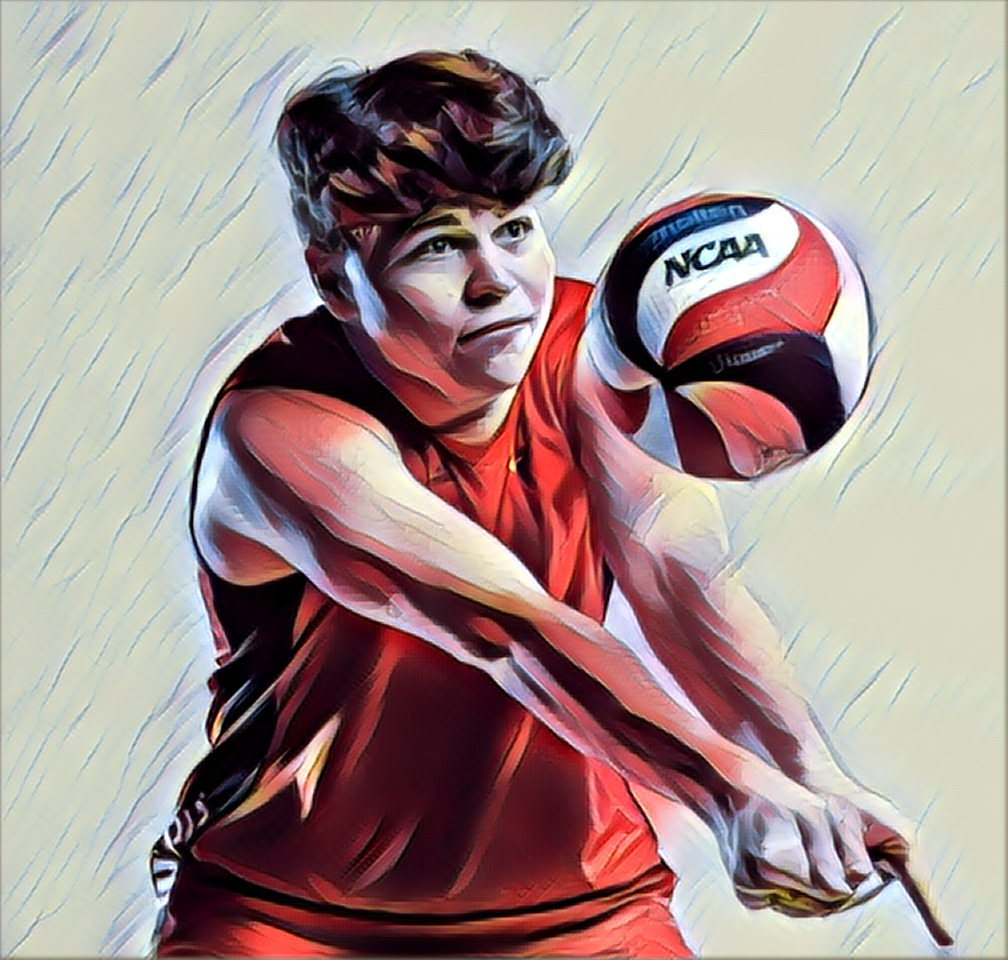
“Who cares if one more light goes out? Well I do.”
2/21/2026
Today, the volleyball community gathers to say goodbye to Henry Kellen Blackmore. He was 18 years old. He was a freshman at North Central College. He was a libero. He was the happiest voice in the gym.
He was someone’s son, someone’s brother, someone’s teammate.
And now he is gone.
There are moments in this sport when everything stops. The ball drops. The whistle goes silent. The gym empties out. And in that quiet, you understand something you cannot unsee: that the people who fill these courts, who run these lines and dive on these floors and yell from these benches, are not permanent. They are not guaranteed. They are gifts, every last one of them, and sometimes the gifts get taken back far too soon.
This is one of those moments.

Henry Blackmore was born on March 2, 2007, in Geneva, Illinois, and from the very beginning, he was the kind of kid who made you pay attention. He walked at eight months old. He taught himself to read before he turned two. When he was three, in an act of pure, glorious determination, he packed three goldfish into a lunchbox and walked two blocks to the elementary school on his own, because he wanted to be wherever his older siblings were. He did not want to miss out. He never wanted to miss out.
That instinct, to be in the middle of it all, to be part of something bigger than himself, defined him for the rest of his life.
He was the kid at the t-ball game who hit the ball and then, just for fun, pulled a second ball from his pocket and threw it into center field to throw off the defense. He was six years old. The crowd lost it. That was Henry: clever, joyful, always looking for the angle that would make the moment better, funnier, more alive.
He grew into a young man who loved board games at the family table and summer fishing derbies at Fish Lake and the feeling of being surrounded by people he loved. He excelled at math. He dreamed of becoming a teacher. He carried a heart big enough for every room he walked into.
And then there was volleyball.
Henry found the sport and the sport found him right back. He played for Geneva Community High School, for Future Volleyball Club, and eventually earned an academic scholarship to North Central College, where he joined the men’s volleyball program as a freshman libero. He stood 5’10”, weighed 145 pounds, and brought something to the court that no scouting report can measure.
He was the happiest presence in the gym.
Head Coach Kevin Kustura wants to make sure you understand the distinction. Not the loudest. The happiest. There is a difference, and it matters. Loud is easy. Loud is performance. Happy, genuinely, consistently, infectiously happy, that takes something more. That takes a person who has made a choice, every single day, to give the people around them the best of what he has.
Henry made that choice every time he walked through the doors.
He also made it from a distance. Even before he arrived on campus, while he was still a high school kid who had committed to North Central, Henry would reach out and ask to come hang out with the guys. Not to practice. Not for a recruiting visit. Just to be around his future teammates, because that was where he wanted to be. Coach Kustura remembers it clearly. Henry had not played a single college match yet and he already considered these people his people.
And when the team group chat would go quiet, it was Henry who broke the silence. Every time. “What’s up chat.” Just like that. Three words, and the conversation came back to life. Because Henry could not stand the idea of his people drifting apart, even for a few hours, even over text. He was the connective tissue of that team before he ever set foot on the college court.
In his college essay, he wrote about what volleyball meant to him with a clarity that most adults never find about anything:
“Being neurodiverse is hard but I did better in school. The sport has also provided me a constant stress-reliever during challenging times, a place where I can channel my emotions. Now, as I look to the future, I am excited. Whether I continue to play competitively, casually, or even coach, volleyball will always hold a special place in my heart.”
Read that again. He knew volleyball was more than a game. He knew it was the thing that held him together. He knew it was a sanctuary. And even as he was dealing with battles the rest of the court could not see, he kept showing up. He kept smiling. He kept being the happiest presence in the room.
That is not weakness. That is extraordinary courage.

Henry Blackmore died on February 8, 2026, after a long struggle with his mental health. He was 18 years old, and he was carrying something that the game and the brotherhood and the happiness could not fully reach.
We say this plainly because the alternative, the silence, the vague language, the careful stepping around the truth, does not serve Henry. It does not serve the next Henry. And in a sport where toughness is the currency and vulnerability is still too often treated as a liability, that silence can cost lives.
Henry was neurodiverse. He said so himself, in his own words, in his own essay. He knew what it was to work harder than those around him for the same result. He knew what it was to find a crowd and use it as armor against the hard days. He knew what it was to fight from the inside while projecting everything outward. He did this beautifully, for years, on courts and in classrooms and at family tables and at fish derbies in the middle of summer.
He did not lose a fight because he was weak.
He fought harder than most of us ever will.
The North Central College men’s volleyball program released a statement after his passing that said, in part: “Brotherhood and family is something that is talked about within our program constantly. We are family and brothers for each other on and off the court.”
That language matters. Because what it means, what it has to mean, is that brotherhood is not just for the wins and the road trips and the team dinners. It is for the quiet moments when someone is not okay and cannot say it. It is for the check-in texts at 10pm. It is for the walk back to the dorms after a hard loss when you stay a little longer because something in your gut tells you to.

Henry gave that brotherhood freely to everyone around him. He volunteered at volleyball clinics for younger kids. He helped at tournaments. He was the first to cheer and the last to walk off the court.
His team deserved to give it back.
All of our teams deserve to give it back.
There is a Linkin Park song that became a kind of anthem for grief when it was released, written in the wake of loss, asking the question that hangs over every community when someone disappears:
Who cares if one more light goes out in the sky of a million stars?
The answer, the only answer that matters, is in the final line.
Well I do.
Henry Blackmore was not one light among a million. He was the happiest light in the room. He flickered and he burned and he warmed every person who stood near him, and the world is darker today because he is not in it.
But here is what does not go out: the way he made his teammates feel seen. The little kids at the volleyball clinics who watched him and decided the sport was worth loving. The laugh that could fill a gymnasium. The college essay that told the truth about what it means to be different and to find your place anyway. The image of a three-year-old with a lunchbox full of goldfish, determined to get to the people he loved.
Those things do not go out.

To Henry’s family, David and Kelly, Sophie, Nathan, Sarah, and everyone who carries him, this community sees you. From a respectful distance, from gyms and courts and living rooms across the country, we are holding you in our thoughts today and in every match that follows.
To Henry’s teammates at North Central, there is no roadmap for what you are walking through. Grief on a team is its own kind of weight, distributed unevenly, carried differently by everyone. Be patient with each other. Say the things out loud. Leave the chair at the table.
And to everyone else who reads this, who pulls it up between matches or during warm-ups or late at night when the day has finally gone quiet: if there is someone in your orbit who is fighting something you cannot see, reach out. Not tomorrow. Not after the next tournament. Today.
Because Henry Blackmore spent his whole short life showing up for other people, cheering them on, breaking the silence when it crept in, being the happiest proof that someone cared.
We owe it to him to do the same.
Henry broke the silence every time. He could not stand the idea of his people going quiet.
The group chat is silent now.
What’s up, chat. We miss you.
If you or someone you know is struggling, the 988 Suicide and Crisis Lifeline is available 24/7 by calling or texting 988. The Jed Foundation, jedfoundation.org, provides mental health support and resources for teens and young adults.

We Did Not Ask For This Room
We did not ask for this room,
or this music;
we were invited in.
Therefore,
because the dark surrounds us,
let us turn our faces to the light.
Let us endure hardship
to be grateful for plenty.
We have been given pain
to be astounded by joy.
We have been given life
to deny death.
We did not ask for this room,
or this music.
But because we are here,
let us dance.